Salesforce Certified Platform Developer 1 Exam Dumps July 2026

PDF + Test Engine
$105 $74
Test Engine
$85 $60
PDF
$65 $46
Here are Salesforce CRT-450 PDF available features:
204 questions with answers
Updation Date : 16 Jul, 2026
1 day study required to pass exam
100% Passing Assurance
100% Money Back Guarantee
Free 3 Months Updates
Salesforce CRT-450 Sample Questions
Question # 31
A developer created this Apex trigger that calls Myclass.myStaticMethod:

The developer creates a test class with a test method that calls MyClass.myStaticMethod directly, resulting in 81% overall code coverage.What happens when the developer tries to deploy the trigger and two classes to production, assuming no other code exists?
A. The deployment passes because both classes and the trigger were included in thedeployment. B. The deployment fails because no assertions were made in the test method. C. The deployment passes because the Apex code has the required >75% code coverage. D. The deployment fails because the Apex trigger has no code coverage.
Answer: C Explanation: The deployment will pass because the Apex code has the required >75% code coverage.In Salesforce, one of the prerequisites for deployment is that the Apex code must have atleast 75% test coverage. This means that at least 75% of your Apex script must beexecuted by your test classes. Since in this case, the overall code coverage is 81%, itexceeds the minimum requirement, allowing for successful deployment. However, it is not abest practice to rely on indirect code coverage from other classes or triggers. Thedeveloper should write a separate test class for the trigger that covers all the possiblescenarios and outcomes. Additionally, the test method should include assertions to verifythe expected behavior and results of the code. References:Apex Developer Guide)Testing Apex - Trailhead)Free Salesforce Platform Developer 1 Practice Exam (With Answers))
Question # 32
What are two benefits of using declarative customizations over code? Choose 2 answers
A. Declarative customizations automatically update with each Salesforce release. B. Declarative customizations generally require less maintenance. C. Declarative customizations automatically generate test classes. D. Declarative customizations cannot generate run time errors.
Answer: A,B Explanation: Declarative customizations are the ones that can be done using the point-and-click toolsprovided by Salesforce, such as Process Builder, Flow Builder, Lightning App Builder, etc.Code customizations are the ones that require writing Apex, Visualforce, or Lightning WebComponents. Some of the benefits of using declarative customizations over code are:Declarative customizations automatically update with each Salesforcerelease. This means that whenever Salesforce improves or adds a new feature toits declarative tools, the existing customizations will be compatible and takeadvantage of the enhancement without any additional effort from the developer1.Declarative customizations generally require less maintenance. This is becausedeclarative customizations are easier to create, modify, and debug than codecustomizations. They also do not require writing test classes or deploying todifferent environments, which can save time and resources2.The other two options are not true benefits of declarative customizations over code:Declarative customizations do not automatically generate test classes. Testclasses are only required for code customizations, and they have to be writtenmanually by the developer. Test classes are used to ensure the quality andfunctionality of the code, and to meet the code coverage requirement fordeployment3.Declarative customizations can still generate run time errors. Run time errors arethe ones that occur when the application is running, and they can be caused byvarious factors, such as invalid data, logic errors, or system limits. Declarativecustomizations are not immune to run time errors, and they have to be handledproperly by the developer using error handling techniques.References:Clicks Not Code: Benefits of Declarative Vs. Imperative Programming - Salesforce)When to Click Instead of Write Code - Salesforce Developers)Apex Testing - Salesforce Developers)Error Handling in Flows - Salesforce Help)
Question # 33
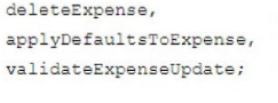
A developer identifies the following triggers on the Expense __c object: The triggers process before delete, before insert, and before update events respectively. Which two techniques should the developer implement to ensure trigger best practices are followed?
Choose 2 answers
A. Create helper classes to execute the appropriate logic when a record is saved. B. Unify the before insert and before update triggers and use Flow for the delete action. C. Unify all three triggers in a single trigger on the Expense__c object that includes allevents. D. Maintain all three triggers on the Expense__c object, but move the Apex logic out of thetrigger definition.
Answer: A,D Explanation:According to the Salesforce Platform Developer I learning objectives and documents, bestpractices for triggers include modularizing code by using helper classes and ensuring that the trigger only contains logic to determine which records to process. The actualprocessing should be done in a separate class. This makes the code more organized,reusable, and easier to test. So options A and D are correct.Option A suggests creating helper classes to execute the appropriate logic when arecord is saved, aligning with best practices of modularizing code.Option D suggests maintaining all three triggers but moving the Apex logic out ofthe trigger definition, which also aligns with best practices.Option B is incorrect because unifying before insert and before update triggers and usingFlow for delete action is not a standard practice mentioned in the learning materials.Option C is incorrect because although it’s often a good practice to have one trigger perobject, it’s not about including all events but about organizing code execution properly.References:Apex Developer GuideTrailhead: Apex Basics for Admins
Question # 34
A developer created a Visualforce page and custom controller to display the account type field as shown below. Custom controller code:
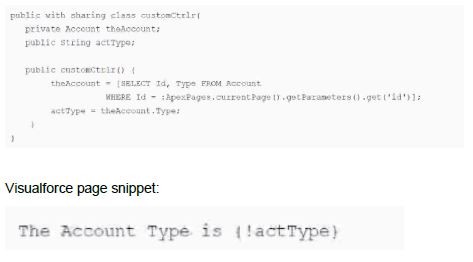
The value of the account type field is not being displayed correctly on the page. Assuming the custom controller is properly referenced on the Visualforce page, what should the developer do to correct the problem?
A. Convert theAcccunt, type to a String. B. Change theAccount attribute to public. C. Add with sharing to the custom controller. D. Add a getter method for the actType attribute.
Answer: D Explanation:The issue is that the value of the account type field is not being displayed correctly on theVisualforce page. This can be resolved by adding a getter method for the actType attributein the custom controller. A getter method is used to retrieve the value of a private variable,ensuring that it’s read-only and cannot be modified by external classes or pages, thusmaintaining encapsulation and security. References: The need for getter methods and theirusage can be referenced in Apex basics where encapsulation, getters, and setters arediscussed: Apex Basics & Database
Question # 35
A developer needs to make a custom Lightning Web Component available in the Salesforce Classic user interface. Which approach can be used to accomplish this?
A. Wrap the Lightning Web Component In an Aura Component and surface the AuraComponent as a Visualforce tab. B. Embed the Lightning Web Component is a Visualforce Component and add directly tothe page layout. C. Use the Lightning Out JavaScript library to embed the Lightning Web Component in aVisualforce page and add to the page layout. D. Use a Visualforce page with a custom controller to invoke the Lightning WebComponent using a call to an Apex method.
Answer: C Explanation: The approach that can be used to make a custom Lightning Web Component available inthe Salesforce Classic user interface is to use the Lightning Out JavaScript library toembed the Lightning Web Component in a Visualforce page and add to the page layout.Lightning Out is a feature that allows developers to use Lightning web components andAura components outside the Lightning Experience and Salesforce app, such as inVisualforce pages, standalone apps, or external websites. By using Lightning Out,developers can leverage the benefits of Lightning Web Components, such as performance,interoperability, and modern web standards, in the Salesforce Classic user interface. Touse Lightning Out, developers need to create a Lightning dependency app, which is aspecial type of Aura app that acts as a bridge between the Lightning web component andthe Visualforce page. Then, developers need to use the $Lightning.use() and$Lightning.createComponent() methods in the Visualforce page to load the dependencyapp and create an instance of the Lightning web component. Finally, developers need toadd the Visualforce page to the page layout of the object where they want to display theLightning web component. References: Use Lightning Web Components in VisualforcePages, Lightning Out, Free Salesforce Platform Developer 1 Practice Exam (With Answers)
Question # 36
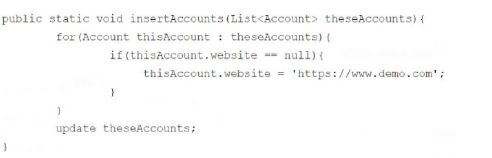
A developer needs to prevent the creation of Request__c records when certain coVraitions exist in the system. A RequeatLogic class exists that checks the conditions. What is the correct implementation?
A. Option A B. Option B C. Option C D. Option D
Answer: D Explanation:The correct implementation is option D, where the trigger is set to execute before theinsertion of a Request__c record. It calls the validateRecords method from theRequestLogic class to check if certain conditions are met before allowing the creation of anew record. This ensures that validation occurs prior to record insertion, preventing thecreation of records that do not meet specified conditions. References: The explanation canbe inferred from knowledge on triggers and their execution context as per Salesforcedeveloper documentation and learning materials available on[Trailhead](1(https://trailhead.salesforce.com/content/learn/modules/apex_triggers%29.
Question # 37
Which statement should be used to allow some of the records in a list of records to be inserted if others fail to be inserted?
A. Database.insert (records, false) B. insert records C. insert (records, false) D. Database.insert (records, true)
Answer: A Explanation: The statement Database.insert (records, false) should be used to allow someof the records in a list of records to be inserted if others fail to be inserted. This statement uses the Database class method insert with the allOrNone parameter set to false. Thismeans that the operation allows partial success, and if some records fail, the remainder ofthe DML operation can still succeed. The method returns a listof Database.SaveResult objects, which contain the status and error information for eachrecord. The developer can use this information to handle the failed records accordingly.The other statements either use the standard DML statement insert, which rolls back theentire transaction if any record fails, or use the allOrNone parameter set to true, which hasthe same effect as the standard DML statement. References: Database Class, Insertingand Updating Records, Database.insert(list,false) in apex
Question # 38
A developer created a trigger on a custom object. This custom object also has some dependent pick lists. According to the order of execution rules, which step happens first?
A. System validation is run for maximum field lengths. B. The original record is loaded from the database. C. Old values are overwritten with the new record values, D. JavaScript validation is run In the browser.
Answer: D Explanation:According to the order of execution rules, the first step that happens when a record issaved is the JavaScript validation on the browser, if the record contains any dependentpicklist fields. This validation limits each dependent picklist field to its available values. Noother validation occurs on the client side. The other steps happen later on the server side,after the record is submitted to the server. References:Triggers and Order of Execution, Apex Developer Guide, Section: Triggers andOrder of ExecutionLearn Salesforce Order of Execution, Salesforce Ben, Section: Order of Executionfrom Developer Docs API v54
Question # 39
When the code executes, a DML exception is thrown. How should a developer modify the code to ensure exceptions are handled gracefully?
A. Implement the upsert DML statement. B. Implement Change Data Capture. C. Implement a try/catch block for the DML. D. Remove null items from the list of Accounts.
Answer: C Explanation: This is because when a DML exception is thrown, it means that the operationfailed due to some error, such as a validation rule, a trigger, or a governor limit. If theexception is not handled, it will cause the entire transaction to roll back and display anunhandled exception message to the user. To handle exceptions gracefully, the developershould use a try/catch block to catch the exception and handle it in a way that does notdisrupt the user experience, such as logging the error, displaying a custom message, orretrying the operation. References: The use of try/catch blocks for handling exceptions iscovered under Apex basics on Trailhead1. You can also find more information on DMLexceptions and how to handle them in the Apex Developer Guide2.
Question # 40
A software company is using Salesforce to track the companies they sell their software to in the Account object. They also use Salesforce to track bugs in their software with a custom object, Bug__c. As part of a process improvement initiative, they want to be able to report on which companies have reported which bugs. Each company should be able t report multiple bugs and bugs can also be reported by multiple companies. What is needed to allow this reporting?
A. Roll-up summary field of Bug__c on Account B. Junction object between Bug__c and Account C. Lookup field on Bug__c to Account D. Master-detail field on Bug__c to Account
Answer: B Explanation:To allow reporting on which companies have reported which bugs, a junction objectbetween Bug__c and Account is needed. A junction object is a custom object with twomaster-detail relationships, one to each of the objects it is joining. A junction object allowsmany-to-many relationships between objects, such as Bug__c and Account in thisscenario. With a junction object, each bug can be related to multiple accounts, and eachaccount can be related to multiple bugs. A roll-up summary field, a lookup field, or amaster-detail field would not allow this kind of relationship, as they only support one-tomanyor one-to-one relationships between objects. References:Define Relationships Between Custom Objects (Trailhead Module)Relationships Among Objects (Salesforce Developer Documentation)Free Salesforce Platform Developer 1 Practice Exam (With Answers) (SalesforceBen)